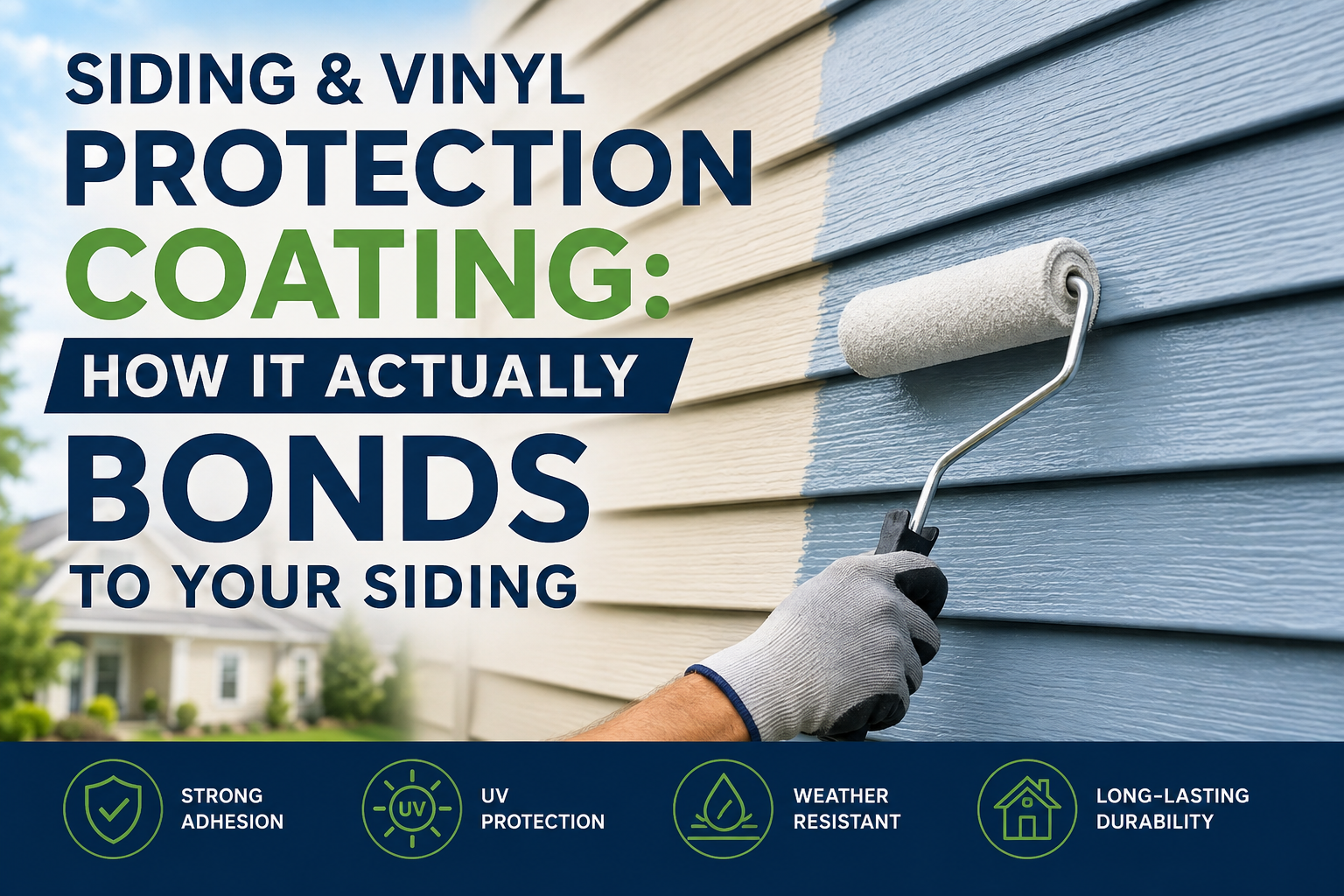

Your siding does more than improve your home’s appearance. It helps protect your exterior from sunlight, moisture, dirt, temperature changes, and everyday weather exposure. But over time, vinyl and other siding materials can fade, become chalky, lose their original finish, or simply look worn out.
That is where a siding and vinyl protection coating can make a difference.
But how does a coating actually bond to siding? Does it simply sit on the surface, or does it chemically and mechanically attach to the material?
The answer depends on the siding material, surface preparation, coating formulation, and application process.
A siding and vinyl protection coating is a specially formulated exterior coating designed to adhere to siding surfaces and create a protective finish.
Unlike ordinary house paint, a quality siding coating is formulated with exterior exposure in mind. It needs to handle conditions such as:
The goal is not simply to change the siding’s color. A properly selected coating can also help create a durable protective surface while improving the appearance of aging siding.
A coating bonds to vinyl siding primarily through surface adhesion.
The coating is applied to a properly prepared siding surface. As it spreads, its resins interact with the surface and form an adhesive film as the coating dries and cures.
The strength of that bond depends on several factors:
In simple terms, the coating needs a clean, compatible surface so its resin system can form a strong, continuous film.
Even the best siding coating cannot perform properly if it is applied over a contaminated surface.
Before coating, the siding should generally be inspected and cleaned to remove materials that could interfere with adhesion.
Common contaminants include:
This preparation gives the coating a better surface to bond with.
Think of it like applying a sticker: if the surface is dirty or covered with loose material, the adhesive cannot make reliable contact.
Whether primer is required depends on the specific coating system, condition of the siding, and manufacturer’s application requirements.
Some coatings are formulated to adhere directly to properly prepared vinyl siding. Other situations may call for a compatible primer, particularly when dealing with certain substrates, stains, repairs, or adhesion challenges.
The important rule is simple:
Do not assume that every primer or paint is compatible with vinyl siding.
Always follow the coating manufacturer’s instructions for preparation, compatibility, and application.
After application, the coating begins to dry and cure.
During this process, the liquid coating gradually develops into a solid protective film. The resin system helps hold the coating together while allowing it to remain bonded to the prepared siding surface.
A quality exterior coating should also be able to accommodate the normal movement of siding caused by changing temperatures.
This matters because exterior siding can experience repeated heating and cooling throughout the year.
A rigid coating that cannot tolerate normal substrate movement may be more likely to crack, peel, or fail prematurely.
Not all exterior paints are designed specifically for siding.
Best for: homeowners looking for a coating system specifically suited to exterior siding.
Potential advantages include:
Best for: exterior surfaces where the particular paint is confirmed to be compatible.
Potential limitations include:
For vinyl siding, a coating specifically formulated and approved for the substrate is generally the safer choice than selecting a generic exterior paint based only on color or price.
The product’s technical specifications matter more than the label saying “exterior.”
A coating does not automatically fail because the coating itself is poor. Application and surface conditions can also play a major role.
Common causes of premature coating problems include:
Good adhesion starts before the coating is applied.
A properly formulated exterior coating can help create a surface that is designed to withstand outdoor exposure, including sunlight.
UV radiation can contribute to fading and surface deterioration over time. A protective coating can provide an additional finish layer between the siding and the environment.
However, no exterior coating should be considered completely immune to weathering.
Performance depends on factors such as:
There is no single lifespan that applies to every siding coating.
Durability depends on the coating product, siding condition, climate, preparation, application, and exposure.
A professionally prepared and properly coated surface can generally perform much better than one that was quickly painted over without preparation.
Instead of choosing a product solely because it promises a specific number of years, homeowners should look at the manufacturer’s documented performance information, warranty terms, preparation requirements, and substrate compatibility.
In some situations, coating can be a practical alternative to replacement.
Coating may make sense when:
Replacement may make more sense when:
The key question is not simply “Can I coat it?” but “Is the existing siding in good enough condition to justify coating?”
A siding and vinyl protection coating bonds through a combination of proper surface preparation, coating-to-substrate compatibility, resin adhesion, and curing.
The process can be summarized in four steps:
Clean surface → Compatible coating → Proper application → Curing and film formation
When these elements work together, the coating can form a continuous exterior film that improves the appearance of siding while providing a protective finish.
For homeowners, the biggest takeaway is simple: successful siding coating is not just about applying paint. It is about creating the right conditions for the coating to adhere, cure, and withstand exterior exposure.
Before coating your siding, always confirm that the product is specifically recommended for your siding material and follow the manufacturer’s preparation and application requirements.
Siding protection coating bonds to vinyl siding through surface adhesion. Proper cleaning removes dirt, mildew, chalk, and other contaminants so the coating can make strong contact with the siding. As the coating dries and cures, its resin system forms a continuous film that adheres to the prepared surface.
Yes, vinyl siding can often be coated instead of replaced when the existing siding is structurally sound and in reasonably good condition. Coating can refresh faded or outdated siding while providing a new exterior finish. Severely damaged, cracked, or deteriorated siding may be better suited for replacement.
Not always. Whether primer is required depends on the specific coating product, siding condition, and manufacturer’s instructions. Some coatings are designed to adhere directly to properly prepared vinyl siding, while certain surfaces or coating systems may require a compatible primer.
Cleaning is important because dirt, grease, mildew, chalk, and loose material can interfere with adhesion. A clean and properly prepared surface gives the coating better contact with the siding, helping create a more reliable and durable bond.
Yes, siding coating can peel or crack if the surface was improperly prepared, the wrong product was used, or the coating was applied under unsuitable conditions. Proper substrate preparation, product compatibility, application technique, and curing conditions can help reduce the risk of premature coating failure.