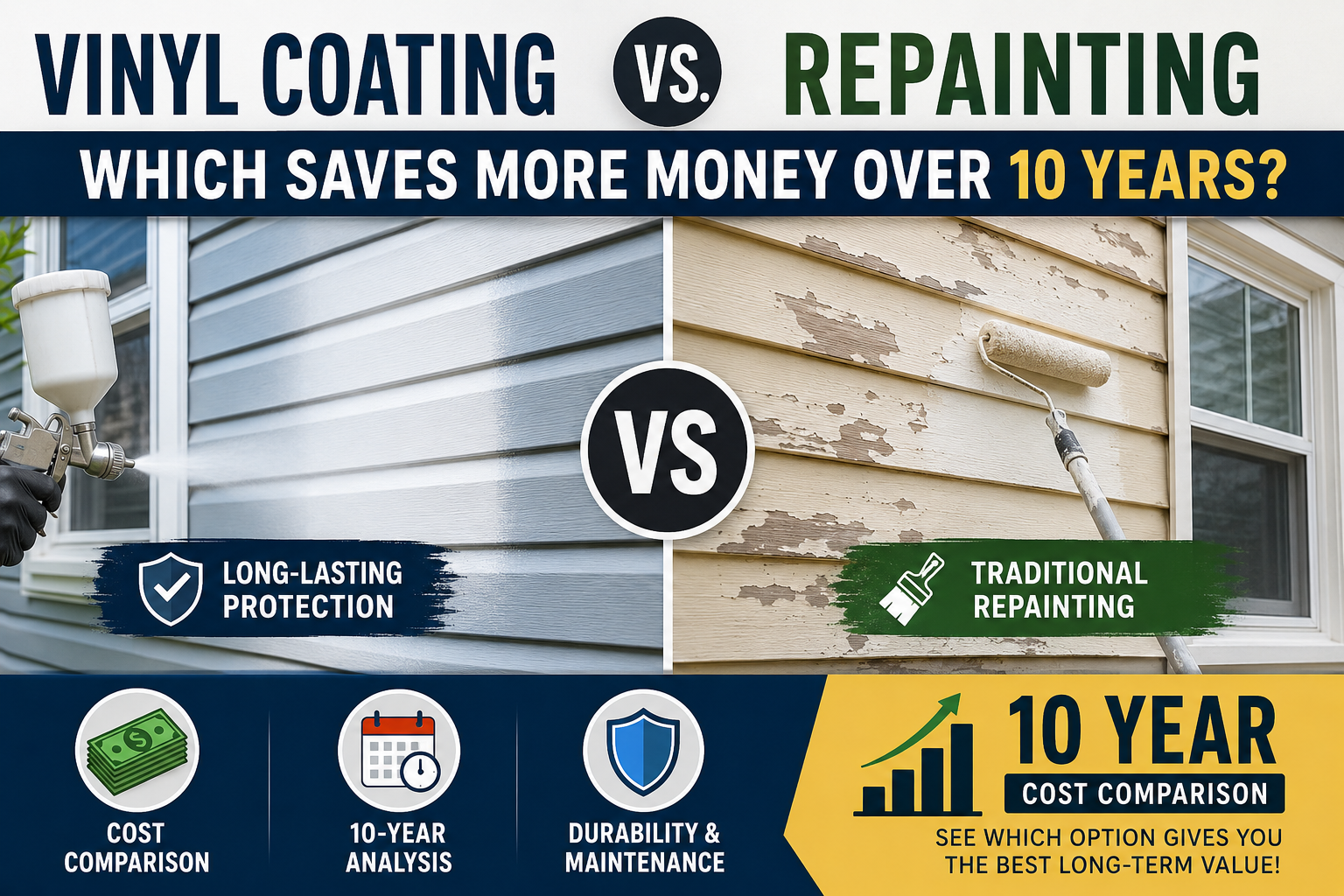

If your vinyl siding looks faded, chalky, or worn, you may be wondering whether it is better to repaint it or apply a long-lasting vinyl coating.
At first glance, repainting can seem like the cheaper option. However, the initial price is only part of the story. Over a 10-year period, maintenance, preparation, labor, recoating, and siding longevity can significantly change the total cost.
So, which saves more money over 10 years? In many situations, a professionally applied long-lasting vinyl coating can offer better long-term value because it may reduce the need for repeated painting and ongoing maintenance.
Let’s compare both options.
A long-lasting vinyl coating is a specialized exterior coating designed to adhere to vinyl siding and provide a durable protective and decorative finish.
Unlike simply changing the color with conventional paint, a quality vinyl coating can be formulated to handle common outdoor challenges such as:
The goal is to give older vinyl siding a refreshed appearance while helping protect the existing material.
Repainting vinyl siding involves preparing the existing surface and applying paint specifically suitable for vinyl and exterior conditions.
The process commonly includes:
The biggest financial consideration is that exterior paint may eventually require another application as the finish weathers.
Repainting may have a lower upfront cost, but long-lasting vinyl coating can potentially provide greater value over a 10-year period.
The important question isn’t simply:
“Which costs less today?”
Instead, ask:
“How much will I spend to keep my siding looking good for the next 10 years?”
That difference is what makes a long-term comparison useful.
The exact price depends on your home’s size, siding condition, location, labor rates, coating system, and preparation requirements.
However, the cost structure generally looks like this:
| Cost Factor | Long-Lasting Vinyl Coating | Repainting |
| Initial application | Moderate to high | Low to moderate |
| Surface preparation | Usually required | Usually required |
| Future maintenance | Potentially lower | Potentially higher |
| Reapplication | May be less frequent | May be needed sooner |
| Color restoration | Yes | Yes |
| Siding replacement avoided | Potential benefit | Potential benefit |
| 10-year value | Potentially strong | Depends on repainting frequency |
A coating that lasts significantly longer can reduce the number of major exterior projects required during the decade.
One reason homeowners choose repainting is the lower entry price.
You pay for the preparation and paint application, and your siding immediately looks refreshed.
But exterior finishes don’t remain new forever.
Over time, you may encounter:
If repainting becomes necessary multiple times during a 10-year period, the total cost can quickly exceed the original estimate.
A long-lasting coating can require a larger initial investment than a basic repainting project.
However, the potential advantage is longevity.
Instead of repeatedly paying for:
Preparation → Painting → Maintenance → Repainting
you may have a longer-lasting exterior finish that requires less frequent major intervention.
That can translate into savings in both money and time.
The answer depends on your priorities.
Choose repainting if:
Consider long-lasting vinyl coating if:
There is another option homeowners often consider: replacing the vinyl siding entirely.
Replacement can provide a completely new exterior, but it is generally a much larger project than refinishing existing siding.
Before replacing siding, ask:
Is the siding actually damaged, or does it simply look old?
If the siding is still structurally sound, a professional coating may provide a way to improve its appearance without immediately paying for full replacement.
This is where coating can become particularly attractive from a renovation-budget perspective.
For homeowners focused on long-term value, the answer depends on how often repainting would need to be repeated.
A simple way to think about the calculation is:
10-Year Repainting Cost = Initial Paint Job + Future Repainting + Maintenance
While:
10-Year Coating Cost = Initial Coating + Any Required Maintenance
If the coating lasts substantially longer and avoids one or more repainting projects, the long-term cost difference can become significant.
The actual savings should be calculated using quotes for your specific property rather than assuming one fixed national price.
Labor can represent a major portion of an exterior painting or coating project.
Every time your home needs another major exterior finish, you may have to pay for:
Doing the project once and maintaining it properly can be more economical than repeatedly starting the entire process over.
A properly selected and professionally applied exterior coating can provide an additional protective finish over vinyl siding.
However, coating is not a solution for severely damaged or failing siding.
Before coating, inspect for:
If the underlying siding is failing, replacement may be more appropriate.
Regardless of which option you choose, preparation matters.
To maximize the lifespan of your exterior finish:
A lower-quality application can cost more in the long run if it requires premature repair or replacement.
Repainting can win on upfront price, while a long-lasting vinyl coating may win on long-term value.
If you’re only looking for a quick cosmetic update and plan to sell soon, repainting may make financial sense.
But if you own the property long-term and want to minimize repeated exterior projects, a durable vinyl coating can be worth considering.
The best decision comes down to more than the initial quote.
Consider the total 10-year cost, expected lifespan, maintenance requirements, siding condition, and labor involved.
Repainting: potentially cheaper today, but repeated applications can increase the total 10-year cost.
Long-lasting vinyl coating: potentially higher upfront investment, but a durable finish may reduce the need for frequent repainting and provide stronger long-term value.
Before making a decision, get estimates for both options and compare their total projected cost over 10 years not just the first invoice.
A long-lasting vinyl coating may cost more initially than repainting, but it can potentially save money over 10 years if it reduces the need for repeated painting and maintenance.
The lifespan depends on the coating system, surface preparation, climate, installation quality, and maintenance. A professionally applied coating can provide a long-lasting finish, but homeowners should always check the specific manufacturer’s durability and warranty information.
Yes. Vinyl siding can generally be painted when it is structurally sound and the correct exterior paint is used. Proper preparation and a vinyl-compatible product are important for achieving good adhesion and durability.
A long-lasting vinyl coating can be an attractive option for faded siding when the existing panels are still in good condition. It can refresh the appearance while providing a new exterior finish without automatically requiring complete siding replacement.
There is no universal repainting schedule. The lifespan of a paint finish depends on the product, preparation, exposure to sunlight and weather, and application quality. Some homes may require repainting sooner than others.