
Vinyl siding is popular because it is durable, low-maintenance, and designed to handle outdoor conditions. But constant exposure to sunlight, rain, humidity, dirt, and temperature changes can gradually affect its appearance.
So, does vinyl siding really need a protective coating?
The short answer is: not always, but a quality vinyl siding coating can provide additional protection and help extend the useful life and appearance of older or weathered siding.
Vinyl siding coating is a specialized exterior coating designed to bond to vinyl siding and provide an additional protective layer.
Unlike ordinary household paint, a proper coating for vinyl siding should be formulated to accommodate the material’s expansion and contraction caused by changing temperatures.
Depending on the product, a vinyl siding coating may help:
The coating should always be compatible with the specific type and condition of the siding.
Vinyl siding does not automatically require a protective coating. Quality vinyl siding is already manufactured to withstand normal outdoor exposure.
However, a protective coating may be worth considering when the siding has become faded, chalky, discolored, or weathered.
A coating can be especially useful when homeowners want to improve the appearance of existing siding without completely replacing it.
Consider a coating when:
A properly selected exterior coating can provide another layer between the siding and environmental exposure.
1. UV Exposure
Continuous sunlight can cause exterior materials to fade over time. A suitable coating can help protect the surface from ongoing UV exposure.
2. Moisture
Rain and humidity constantly expose siding to moisture. A compatible coating can add another protective barrier to the exterior surface.
3. Weathering
Repeated cycles of heat, cold, rain, and sunlight can gradually change the appearance of siding. A flexible coating can help the surface handle normal outdoor conditions.
4. Dirt and Surface Aging
Some coatings create a smoother, renewed exterior surface that can make weathered siding look cleaner and more uniform.
Important: A coating cannot repair severely damaged siding. Cracks, loose panels, major warping, or underlying moisture problems should be addressed before coating.
| Vinyl Siding With Coating | Vinyl Siding Without Coating |
| Adds an additional protective layer | Relies primarily on the original siding |
| Can refresh faded appearance | Existing fading remains |
| May provide additional UV protection | Direct exposure continues |
| Can offer a new exterior finish | Original finish remains |
| May help postpone replacement | Replacement may become the long-term option |
| Requires proper surface preparation | Requires routine cleaning and inspection |
The key difference is that coating is an optional restoration and protection strategy, while untreated siding continues to rely on its original factory finish.
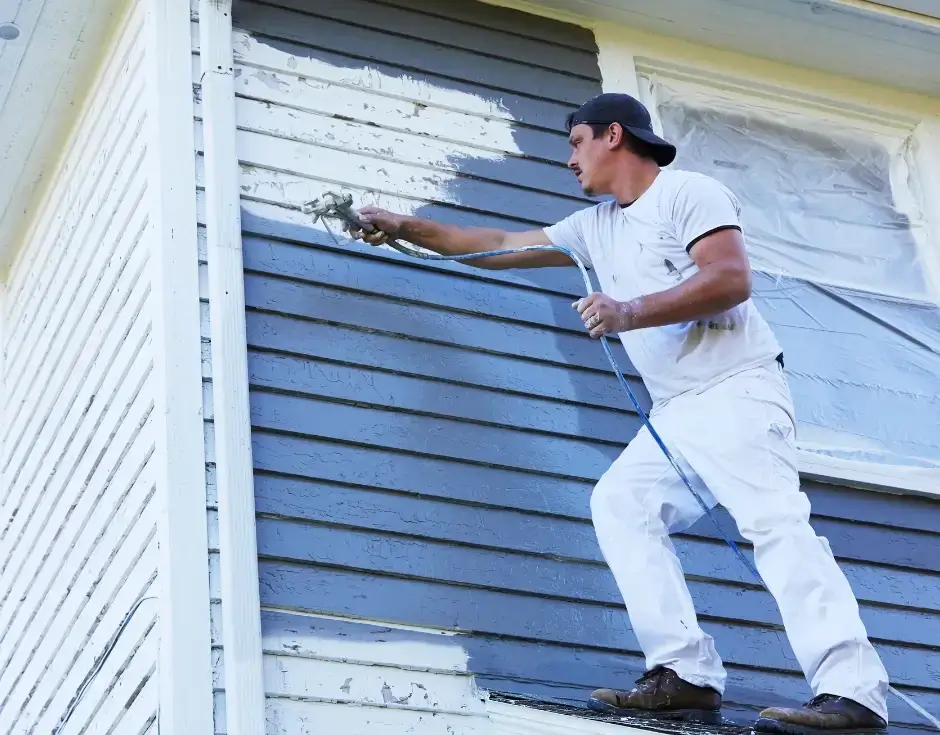
No. Vinyl siding coating and ordinary exterior paint are not necessarily the same thing.
Vinyl expands and contracts as temperatures change. A coating intended for vinyl siding should therefore be formulated with the material’s characteristics in mind.
Using an unsuitable paint or coating can lead to problems such as:
For this reason, homeowners should choose a product specifically designed or approved for vinyl siding rather than treating it like wood, drywall, or another exterior surface.
Yes, some vinyl siding coatings can be used to change the appearance or color of existing siding.
However, color selection matters.
Dark colors can absorb more solar heat than lighter colors. Depending on the siding and coating system, excessive heat absorption may contribute to dimensional changes or other issues.
Before changing the color of vinyl siding, check the coating manufacturer’s recommendations regarding:
The lifespan of a vinyl siding coating depends on the product, preparation, application, climate, and exposure conditions.
There is no single number that applies to every coating.
A high-quality coating applied correctly to properly prepared siding can last considerably longer than a poorly prepared or improperly coated surface.
Factors affecting coating performance include:
Always follow the specific manufacturer’s preparation, application, and maintenance instructions.
Proper preparation is one of the most important steps in a successful vinyl siding coating project.
The surface should generally be:
Dirt, mildew, chalking, grease, or other contaminants can interfere with adhesion.
Why Surface Preparation Matters
Even an excellent coating can perform poorly if it is applied over a dirty, unstable, or damaged surface.
Good preparation creates the foundation for better adhesion and a more uniform finish.
No. A protective coating is not a substitute for repairing or replacing severely damaged siding.
Coating may improve the appearance of weathered siding, but it cannot correct major structural problems.
Look for:
These issues should be evaluated before applying a coating.
Vinyl siding coating can be worthwhile when the existing siding is still in good physical condition but has become faded or unattractive.
It may provide a practical middle ground between doing nothing and replacing all the siding.
Coating may make sense if:
Replacement may make more sense if:
Vinyl siding coating can provide both cosmetic and protective benefits, depending on the product.
A quality coating can transform the appearance of faded siding while also adding another layer of protection against environmental exposure.
However, homeowners should avoid assuming that every coating provides the same performance.
Before choosing a product, check:
Vinyl siding does not require a protective coating simply because it is vinyl. However, vinyl siding coating can be a valuable option for homeowners dealing with fading, weathering, or an outdated appearance.
If the siding is still structurally sound, coating can provide a way to refresh the exterior without immediately committing to complete replacement.
The most important factors are choosing a compatible coating, preparing the siding properly, and applying the product according to manufacturer specifications.
In other words, protective coating isn’t necessarily a requirement for vinyl siding but for the right home, it can be a practical way to restore appearance and add another layer of exterior protection.