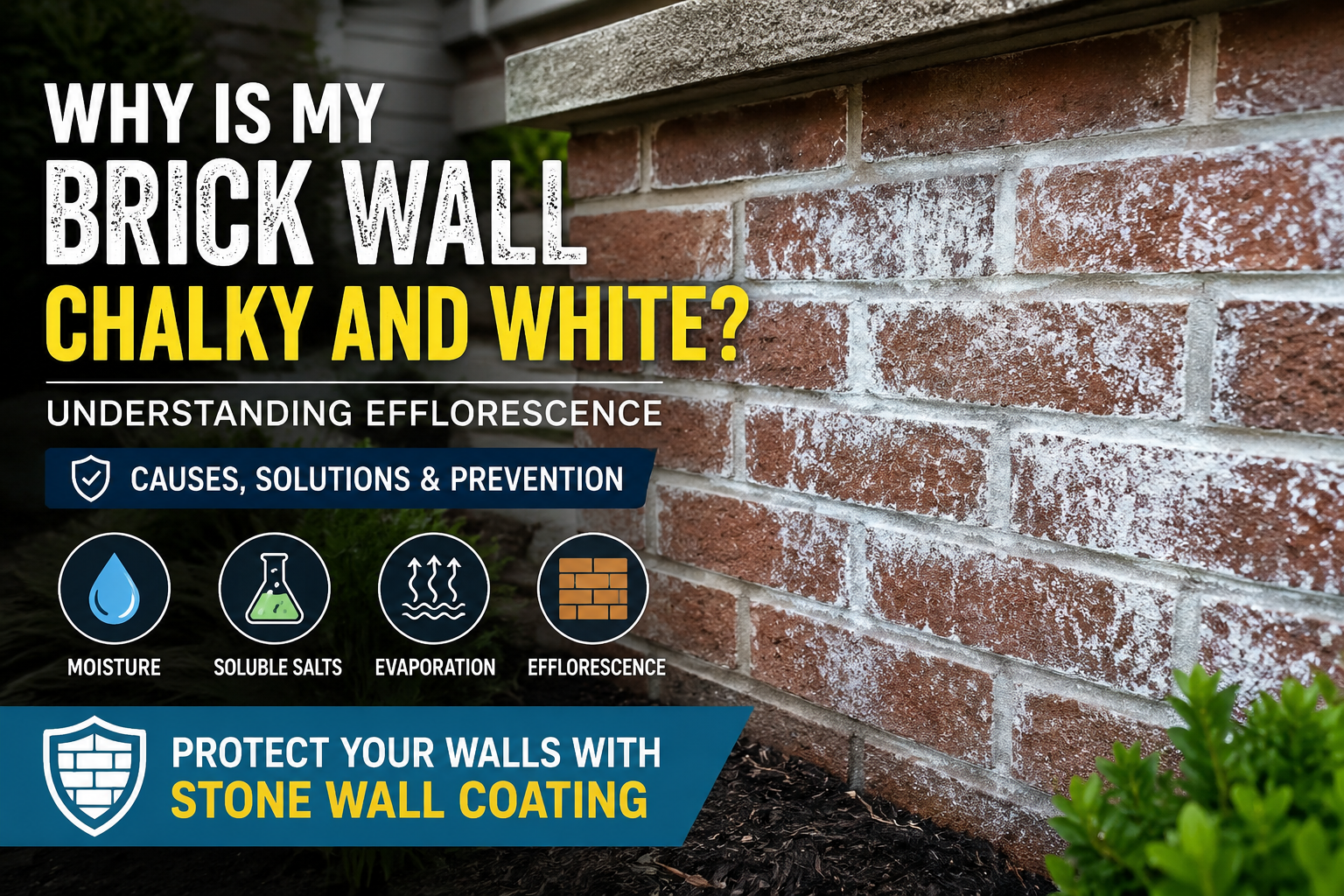

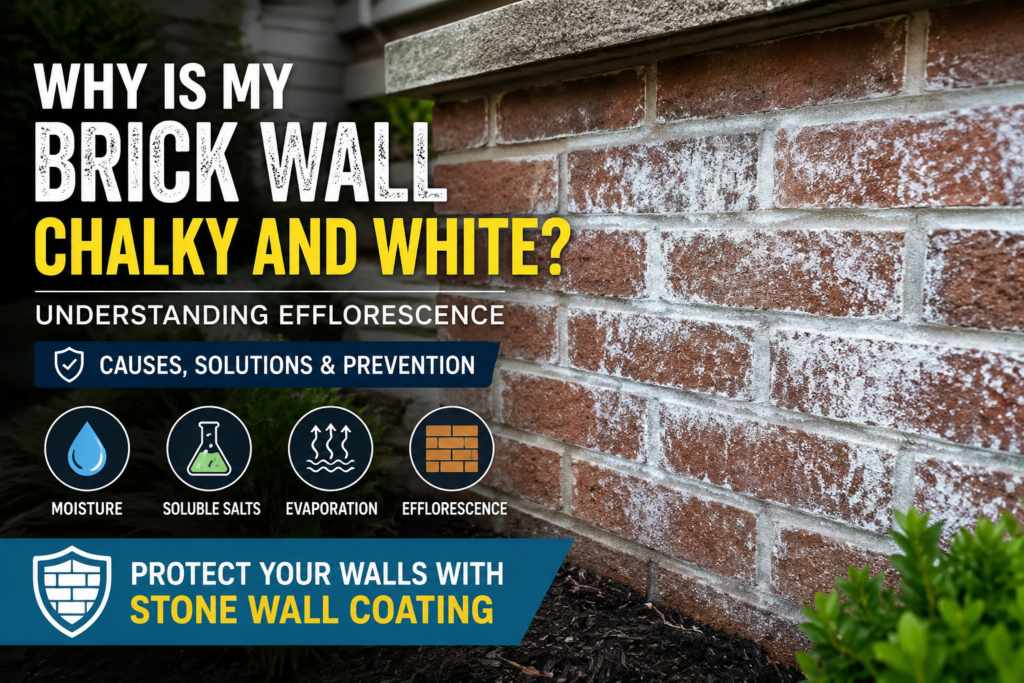
Have you noticed a white, chalky substance appearing on your brick wall? You’re not alone. Many homeowners mistake it for mold, paint damage, or permanent staining. In reality, it is often efflorescence, a common issue caused by moisture and mineral deposits.
While efflorescence itself is usually not dangerous, it is often a warning sign that water is moving through your masonry. If ignored, the underlying moisture can eventually contribute to more serious problems, including cracking, spalling, mold growth, and structural deterioration.
If you’re searching for information about Stone Wall Coating, this guide explains what efflorescence is, why it happens, how to remove it, and how protective coatings can help prevent it from returning.
Efflorescence is a white, powdery mineral deposit that forms on the surface of brick, stone, concrete, or mortar.
It develops when:
The white residue may look harmless, but it tells you one important thing:
Moisture is moving through your wall.
That moisture movement not the white powder itself is usually the bigger concern.
Efflorescence requires three conditions:
1. Water
Moisture enters the wall from:
Without water, efflorescence cannot form.
2. Soluble Salts
Bricks, mortar, concrete, and natural stone naturally contain small amounts of mineral salts.
Common salts include:
These minerals dissolve when exposed to moisture.
3. Evaporation
As water reaches the outside surface, it evaporates.
The minerals remain behind as white crystals.
Over time, repeated wetting and drying cycles create larger chalky deposits.
Common signs include:
It often appears:
The white powder itself is generally not harmful.
However, the moisture causing it can lead to:
Think of efflorescence as a warning light rather than the actual mechanical problem.
Many homeowners clean the white residue only to see it return weeks later.
That’s because cleaning removes the mineral deposits but not the moisture source.
Common causes of recurring efflorescence include:
Unless moisture is controlled, efflorescence usually returns.
| Feature | Efflorescence | Mold |
| Color | White | Black, green, brown |
| Texture | Powdery | Fuzzy or slimy |
| Cause | Mineral salts | Fungi |
| Smell | None | Musty odor |
| Water Required | Yes | Yes |
| Easy to Brush Off | Yes | Usually not |
| Health Concern | Low | Can affect indoor air quality |
A simple test:
Rub the white material with your finger.
By itself, no.
But repeated moisture movement can eventually cause:
The longer moisture remains inside the wall, the higher the risk of permanent masonry damage.
The best removal method depends on how severe the buildup is.
Light Efflorescence
Often removed using:
Never use a wire brush on decorative brick.
Moderate Deposits
Use:
Allow the wall to dry completely afterward.
Heavy Mineral Deposits
Professional masonry cleaning may be required.
Some acid-based cleaners work effectively but can damage brick if improperly applied.
Professional cleaning is usually the safest option for historic or decorative masonry.
Pressure washing may appear to solve the problem.
However, it can actually:
The white deposits often return after the wall dries.
Removing the moisture source is more effective than repeated washing.
One of the most effective long-term solutions is applying a high-quality Stone Wall Coating designed for exterior masonry.
A protective coating creates a barrier that limits excessive water penetration while allowing trapped moisture vapor to escape (when using breathable systems).
Benefits include:
The right coating addresses one of the root causes of efflorescence: excessive moisture entering the wall.
| Feature | Stone Wall Coating | Traditional Masonry Sealer |
| Water Protection | Excellent | Moderate |
| UV Resistance | High | Varies |
| Longevity | Longer-lasting | Often requires frequent reapplication |
| Appearance | Maintains uniform finish | May wear unevenly |
| Moisture Resistance | Superior | Moderate |
| Maintenance | Lower | Higher |
| Weather Protection | Strong | Limited |
| Long-Term Value | Higher | Moderate |
Choosing a quality Stone Wall Coating can provide more durable protection than many standard sealers, especially in climates with frequent rain, snow, or freeze-thaw cycles.
New construction commonly experiences efflorescence during the first year because:
In many cases, minor efflorescence naturally decreases once the wall fully dries over time.
Persistent or worsening deposits, however, should be investigated for ongoing moisture issues.
Preventing efflorescence focuses on keeping excess moisture out of the masonry.
Best prevention methods include:
Addressing moisture early is usually far less expensive than repairing damaged masonry later.
A chalky white brick wall is more than just a cosmetic issue it is often your home’s way of signaling that moisture is moving through the masonry. While efflorescence itself is simply a deposit of mineral salts, the water causing it can eventually lead to costly damage if left unaddressed. The most effective long-term approach combines proper moisture management, timely masonry repairs, and a durable Stone Wall Coating that helps protect the surface from excessive water intrusion while preserving the natural beauty of brick and stone. By addressing the root cause rather than just cleaning the symptoms, homeowners can extend the life of their masonry, reduce maintenance, and keep exterior walls looking their best for years to come.
Not always, but it indicates that moisture is moving through the masonry. Finding the water source is the most important step.
Minor deposits sometimes fade over time, especially on new construction. Persistent buildup usually returns unless the moisture problem is resolved.
No. Painting over efflorescence traps salts beneath the coating and often leads to peeling, bubbling, or paint failure. The deposits should be removed and the moisture source corrected first.
Yes. Natural stone, manufactured stone veneer, concrete block, and brick can all develop efflorescence when moisture carries dissolved salts to the surface.
No coating can eliminate every source of moisture. However, a high-quality breathable Stone Wall Coating significantly reduces water penetration while helping the wall manage moisture more effectively, making recurring efflorescence much less likely.